
Every copier promises "instant". None of them are instant, and the ones that quote a number are the only ones worth reading. The gap between your master account's fill and your follower account's fill is where copy trading quietly loses money — not in the strategy, not in the spread, but in the milliseconds nobody itemises.
Here is how to put a number on it.
What actually happens in that gap
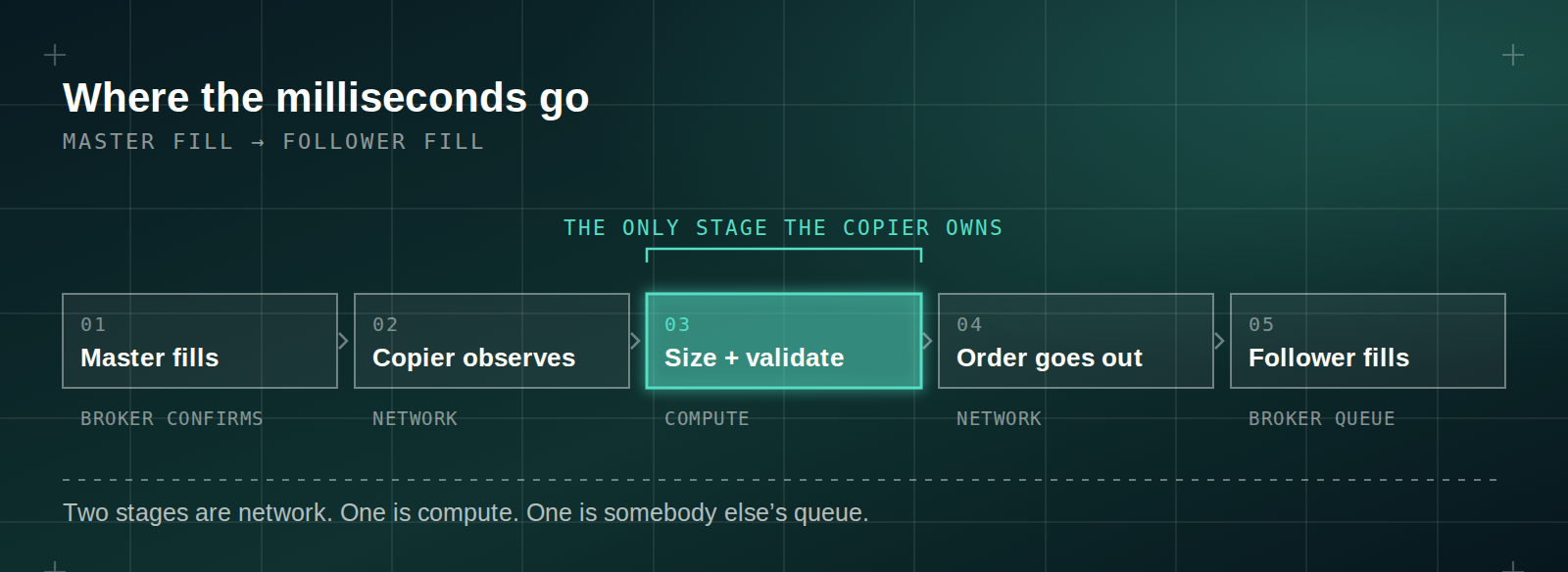
A copied trade is not one event. It is a chain, and every link adds time:
- Your master account fills, and the broker's server emits the confirmation.
- The copier observes that confirmation — either by polling or over a push connection.
- The copier maps the symbol, computes the follower's lot size, and validates it against that account's margin.
- The order goes out to the follower's broker.
- The follower's broker fills it, at whatever the market is now.
Steps 2 and 4 are network. Step 3 is compute. Step 5 is somebody else's queue. Only step 3 is fully under a copier's control, which is why "our software is fast" is a much weaker claim than it sounds.
Turning milliseconds into money
The conversion is unglamorous. Take the instrument's typical movement per unit of time during the sessions you actually trade, and multiply.
On EURUSD in a quiet London hour, price might drift on the order of a tenth of a pip in 30ms — invisible. In the ninety seconds after a US CPI print, the same 30ms can span several pips. Latency does not cost you a fixed amount. It costs you the volatility of the moment you happen to be trading, which is precisely why the cost concentrates in the trades you care most about.
Latency is not a tax on your average trade. It is a tax on your most important ones.
A scalper taking twenty trades a day on news is exposed to it on every entry. A swing trader holding four days is, for practical purposes, immune. Before you spend anything on infrastructure, work out honestly which of those you are.
The four things that actually shorten it
Most of the advice here is folklore. These are the levers with real leverage, roughly in order of effect:
- Physical distance to the broker. Light in fibre covers about 200km per millisecond, and real routes are never straight. A copier running next to your broker's matching engine and one running on a laptop in another country are not the same product. This is the single biggest term, and it is geography, not code.
- Push instead of poll. A copier that polls for new trades every 500ms has a built-in average delay of 250ms before it has done anything at all. That dwarfs everything else on this list.
- Dedicated resources. Shared hosting means your order can sit behind another tenant's workload at exactly the wrong moment. The tail matters more than the average here.
- Pre-computed sizing. If the copier has to fetch account state before it can size the order, that is another round trip inside the critical path.
Read the tail, not the average
An average latency figure is close to useless on its own. What ruins a week is the worst 1% of copies, because those cluster in fast markets — the same moments where the price moves furthest.
Ask for, or measure, the 99th percentile. A copier averaging 25ms with a 400ms tail is worse for a news trader than one averaging 60ms that never exceeds 90ms. Consistency beats speed once you are inside the same order of magnitude.
If you are measuring it yourself, the honest method is to compare fill timestamps — master fill to follower fill — across a few hundred real copies, and plot the distribution rather than quoting the mean. The shape will tell you more than any vendor page.
What to do with this
- If you trade news or scalp, treat execution infrastructure as part of the strategy, not as overhead.
- If you swing trade, stop paying for latency and spend the attention on sizing and risk instead.
- Either way, measure your own fills before you believe a number on a marketing page — including ours.
The goal is not zero latency. It is knowing what yours costs, so it stops being a mystery deduction from an otherwise profitable month.